Grind and Seal Concrete Floor Cost Guide
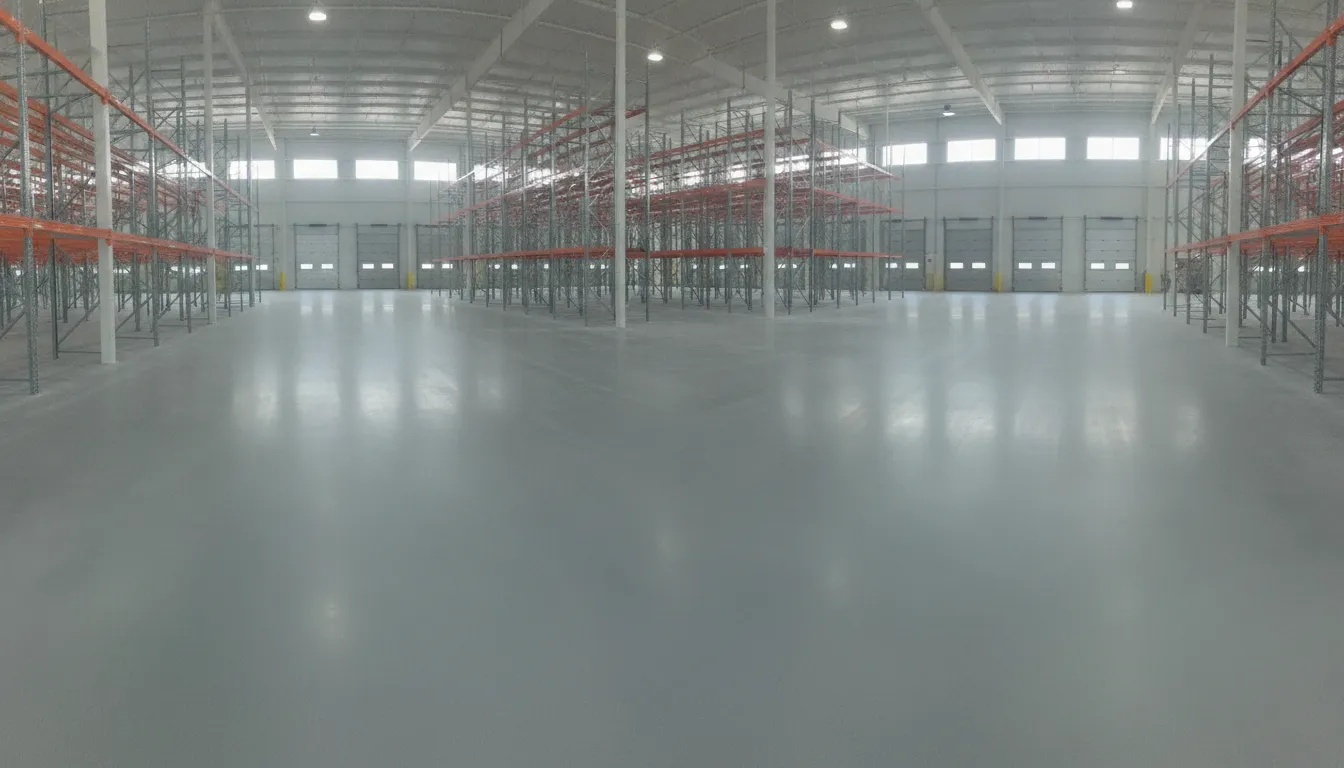
A grind and seal concrete floor cost is usually quoted by the square foot, but the number only means something once someone has looked at the slab. Alliance Epoxy Flooring publishes a typical industry budgeting range of $2 to $5 per square foot for grind and seal. That band is a planning figure, not a company price list. Square footage, how much grinding the concrete needs, and the sealer you choose decide where a real job lands.
Request a free grind and seal estimate
What a grind and seal quote is actually buying
Grind and seal is a two-step finish, not a coating you roll over a dirty slab. The crew diamond-grinds the concrete to take off old coatings, surface stains and high spots, then applies a penetrating or topical sealer. You keep the look of the concrete itself, in matte, satin or gloss. There is no thick resin build like epoxy.
That is why the price sits below a full coating system, and why the quote is mostly labor and access rather than gallons of material. On a warehouse, shop or back-of-house floor, you are paying for a dust-controlled grind, a clean surface, and a sealer matched to traffic. Alliance's grind and seal service is built for warehouses, garages, retail and back-of-house spaces across New York, New Jersey and Pennsylvania.
Most of these floors are walk-on ready within 24 hours, with full service in one to two days, depending on the sealer and site conditions. That short window is part of the value on an operating floor. A cheap quote that ignores dust control, crack repair or cure time is not the same scope.
Read a grind and seal proposal as a scope, not a single rate. A complete commercial quote names the area in square feet and the grind needed to remove coatings or high spots. It also names how cracks and joints will be treated, the sealer and sheen, the number of coats, and when foot traffic and forklifts can return. If those lines are missing, the low number is not comparable to a bid that includes them.
Facility managers usually hit this question during a shutdown window or a tenant turnover, not as a design project. The useful comparison is the cost of living with a dusty. Hard-to-clean slab versus the cost of a one- to two-day grind and seal while the space is empty. Replacing the slab is a different project. It is rarely the cheaper way to get a clean surface when the concrete is still structurally sound.
How the published range breaks down
Use the $2 to $5 per square foot band to size a budget, then treat anything more precise as a guess until the slab is measured. The low end fits a sound, already-clean slab with straightforward access and a simple sealer. The high end fits heavier grinding, old coating removal, repairs, or a higher-build topical sealer.
| Planning case | What the slab is like | How to read the $2 to $5 band |
|---|---|---|
| Light refresh | Sound concrete. Light wear. Open access. | Often nearer $2 to $3 per square foot. |
| Typical commercial floor | Some staining. Minor cracks. Normal warehouse traffic. | Often the middle of the band. |
| Heavy prep | Old coatings. Rough profile. Tight access. | Often nearer $4 to $5. Repairs can sit on top. |
Those rows are reading aids for the published industry band. They are not Alliance prices. A 10,000-square-foot warehouse and a 400-square-foot garage do not share the same price per foot, even when both use the same sealer. Larger open areas usually lower the unit cost because mobilization, setup and cleanup are spread across more floor. Small rooms, stairs, drains and odd layouts do the opposite.
Alliance's epoxy flooring cost guide places grind and seal at $2 to $5, under basic single-coat epoxy at $3 to $6 and polished concrete at $4 to $9. Use that only to see where the system sits. Do not add those bands together or treat them as a bid.
A square-foot rate also hides the fixed part of the job. Mobilizing a grinder, a dust collector, power, and a crew has a floor cost whether the room is 400 square feet or 4,000. On a small garage or a tight back room, that fixed cost pushes the effective rate up even when the sealer itself is simple. On a large open warehouse, the same crew and machines spread across more floor. Which is why big, clean slabs are the jobs most likely to land near the bottom of the band.
Do the arithmetic in both directions before you lock a budget. Multiply the area by $2 and by $5, then add a separate allowance for repairs you can already see. Wide cracks, spalled joints, a failed coating, or racking that cannot move all belong in that allowance. It is not a published Alliance fee. It is the line that keeps a planning number from collapsing when the walkthrough finds more prep than the photos showed.
Worked planning examples, not quotes
These examples only multiply the published $2 to $5 industry band. They are not proposals, and they leave out repairs and add-ons.
- A 500-square-foot garage or small shop, open and lightly worn, plans at about $1,000 to $2,500 before repairs.
- A 2,000-square-foot back-of-house or light industrial bay plans at about $4,000 to $10,000 before repairs.
- A 10,000-square-foot warehouse floor plans at about $20,000 to $50,000 before repairs. The unit rate is more likely to ease on a clean, open slab.
If your space falls between those sizes, scale from the band rather than from a neighbor's invoice. A Manhattan job with a freight elevator and a certificate-of-insurance requirement will not match a suburban slab with a dock door and a clear weekend. A floor that can only close overnight is a different schedule too. Alliance describes night, weekend and holiday scheduling, plus low-odor or fast-cure options and building-access coordination, as Manhattan options. Those notes are not a fee waiver on every address in New York, New Jersey or Pennsylvania.
What changes a grind and seal concrete floor cost
Five things show up on almost every commercial grind and seal quote. Ask for each one in writing so two bids describe the same work. A walkthrough usually uncovers them in this order.
- Confirm the square footage that will actually be ground, including aisles and rooms the crew must move between.
- Note coatings, oil, cracks and joints that need more than a light pass.
- Choose penetrating or topical sealer, the sheen, and how many coats.
- Plan dust control, power, access and whether the building stays occupied.
- Price repairs and add-ons as their own lines, not as a surprise inside the rate.
Square footage and mobilization
Measure the area that will actually be ground, not the whole building. Aisle coverage, equipment pads you must work around, and a second room on another level all change the job. Combining several areas in one visit usually lowers the price per square foot because the crew mobilizes once.
Slab condition
Cracks, spalls, curled joints and old failing coatings add grinding and patching before a sealer can go down. Deep oil can remain visible after grinding. The sealer locks the stain down, but it does not erase it. If the quote assumes a clean slab and yours is coated or oil-soaked, the number will move.
Sealer and sheen
A penetrating sealer is typically the lower material cost and leaves a quieter, more natural look. A topical sealer, or a second coat for gloss, adds material and time. Matte, satin and gloss are finish choices, not free upgrades. Match the sheen to the room: gloss shows more in a showroom, and a lower sheen is easier to live with in a working warehouse.
Access, dust and schedule
Grinding concrete creates silica-bearing dust. Federal construction rules for respirable crystalline silica, in 29 CFR 1926.1153, require controls such as wet methods or local exhaust ventilation on tasks like handheld and walk-behind grinding. A responsible quote includes dust collection or wet grinding, not an open dry grind next to stored product. Night or weekend work, occupied buildings and limited dock access can also add labor.
Add-ons that are not in the base band
Joint fill, crack repair, moisture treatment and anti-slip grit are separate line items when the slab needs them. The cost guide prices add-ons such as anti-slip, cove base and moisture barriers on top of the base system, without a posted dollar amount. If a bid is far below $2 per square foot, check whether prep, dust control or a second coat was left out.
When grind and seal is the right spend
Choose grind and seal when you want a clean, dust-proofed concrete floor without building a thick coating. It fits warehouses, distribution floors, garages, workshops, retail back-of-house and showrooms that can live with the natural color of the slab. With normal commercial use, the floor often goes several years before it needs a fresh topcoat, and that refresh does not require grinding the slab again. Traffic and cleaning habits set the real interval.
Budget the refresh as a future operating cost, not as a failure of the first install. A topical sealer in a forklift aisle will wear faster than a penetrating sealer in a low-traffic stockroom. Daily dust mopping and prompt cleanup of oils and salts extend the interval. Dragging uncovered pallet skids across a new gloss coat shortens it. None of that is a warranty term. Alliance does not publish a written warranty period for grind and seal, so service life stays a maintenance expectation until a proposal states otherwise.
Spend elsewhere when the floor has a different job. A full epoxy system is the better budget when you need a built-up, seamless surface for heavy chemical exposure, a commercial kitchen or a decorative flake look. Polished concrete costs more per square foot in the published guide because densifying and higher sheens take more grinding steps. If you are choosing between those finishes, start with the service page, then price only the system that matches the use. A low grind-and-seal number is not a bargain if the floor needed a coating.
Moisture is the other reason to change systems rather than chase a lower rate. Grind and seal is not a waterproofing membrane. A slab with active moisture, hydrostatic pressure or a below-grade leak needs that problem diagnosed before a sealer is sold as the fix. Covering a wet slab with the cheapest sealer does not make the quote a good one. It makes the next repair more expensive.
What to send so the estimate is usable
A square-foot guess from a phone call is only as good as the description of the slab. These details show whether the published band even applies:
- Approximate area, ceiling height, and whether racking, machines or vehicles have to stay in place.
- Photos of coatings, paint, tile residue, cracks, joints and any dark oil spots.
- How the floor is used: foot traffic, pallet jacks, forklifts, wash-downs, salts or chemicals.
- The sheen you want, and whether a natural gray floor is acceptable.
- Dates the space can be clear, including nights or weekends if the building cannot close.
- City and access notes, such as a dock, a freight elevator or a required certificate of insurance.
Alliance's estimate form also asks whether the project is residential, commercial or industrial, and how soon you want to move. The timing choices are ready now, about 30 days out, one to three months out, or still planning. Urgency changes scheduling. It should not change the honesty of the scope. If two areas need different finishes, say so. Grinding a warehouse and coating a kitchen in the same visit can lower the trip cost, but they remain two systems with two prices.
For a working number, send the square footage, photos of stains or old coatings, the sheen you want, and when the space can be empty. Alliance replies within 24 hours on a free estimate request. That reply is the start of pricing, not a promise that the floor will be inspected, quoted in final form, or installed inside 24 hours.
Talk with Alliance about your floor
Frequently asked questions
How much does grind and seal concrete cost per square foot?
Alliance publishes a typical industry range of $2 to $5 per square foot for grind and seal. A sound, open slab tends toward the low end. Heavy grinding, coating removal and a higher-sheen topical sealer tend toward the high end. The only project price is a written estimate after the slab is seen.
Why do two grind and seal bids differ so much?
They often describe different work. One bid may be a single penetrating sealer on clean concrete. Another may include coating removal, crack repair, dust collection and a gloss topcoat. Compare grind depth, sealer type, coat count and what happens at cracks before you compare the total.
Is grind and seal cheaper than epoxy or polished concrete?
In the published industry bands, yes. Grind and seal is listed at $2 to $5 per square foot, basic epoxy at $3 to $6, and polished concrete at $4 to $9. Cheaper is only better when a sealed natural slab is what the space needs.
How soon can the floor go back into service?
Most grind and seal floors are walk-on ready within 24 hours and back to full service in one to two days, depending on the sealer and conditions. Ask which sealer is specified before you schedule deliveries or forklift traffic.
Does grinding remove oil stains?
Grinding removes surface stains, old coatings and imperfections. Oil that has soaked deep into the slab can still show. The sealer locks that mark down so it stops spreading dust and dirt, but it will not make a badly stained slab look new.