Commercial Epoxy Flooring: What to Review
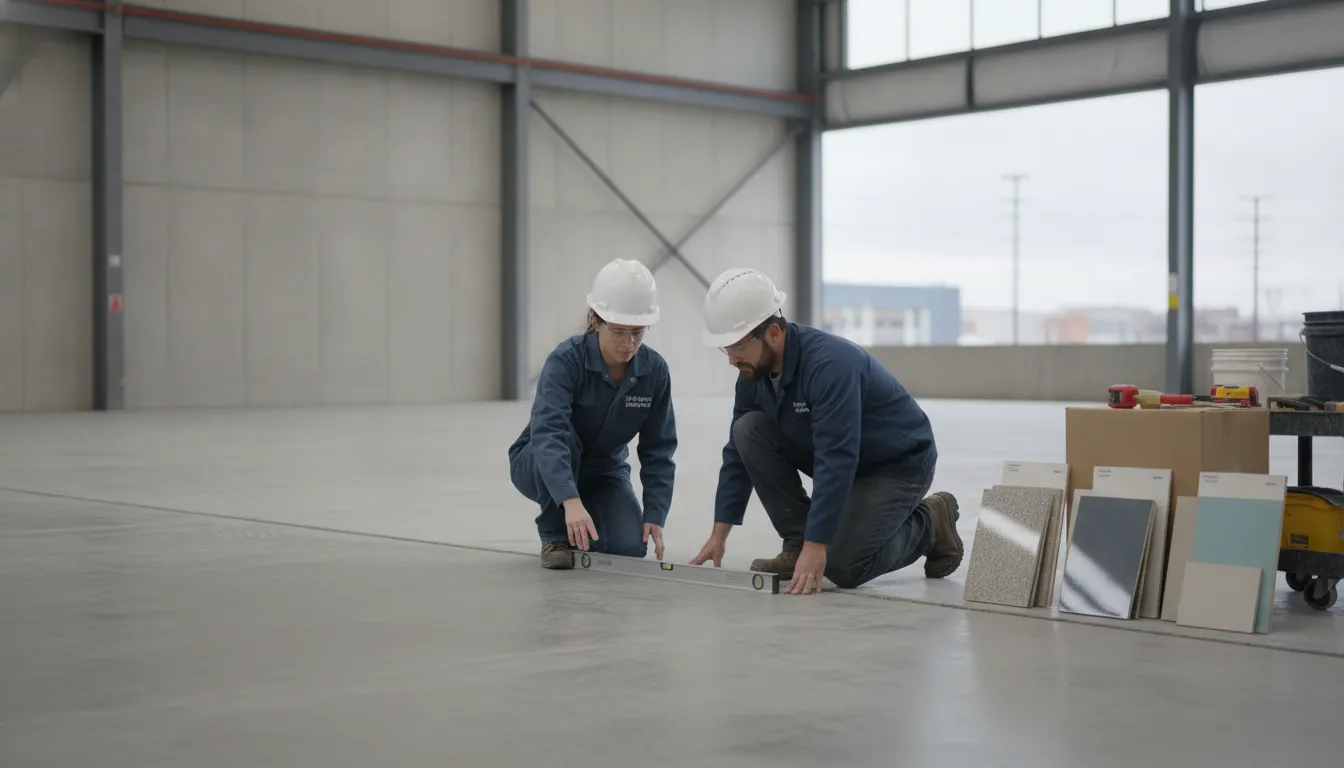
Commercial epoxy flooring is a resin coating system installed over prepared concrete, not a paint color chosen from a chart. Facility buyers should review traffic, cleaning, slab condition, traction, and access before they compare finishes or request a price. Those five conditions decide whether a solid-color, flake, metallic, or colored quartz system is appropriate for the room.
Call (800) 518-9080 to talk through the floor, or request a free estimate.
Alliance Epoxy Flooring installs epoxy coatings for commercial and industrial spaces across New York, New Jersey, and Pennsylvania. The appropriate system is the one matched to how that space operates. A free, no-obligation estimate begins with an assessment of the slab, not a catalog finish.
What commercial epoxy flooring has to handle
A commercial floor is a working surface. People walk it, carts roll across it, and cleaning crews expose it to water and chemicals. The coating must survive that routine, not merely look uniform on the first day.
Buyers often start with color, and that order is backwards. Color is the last decision. The first decision is what the floor must survive until the next planned shutdown. Skip that review and you can pay for a finish that looks correct on a sample board and then fails in the aisle you actually use.
Record the review in the order an installer will use it: traffic, then cleaning, then the slab, then traction, then access. A sample board cannot answer those questions. Only the building can.
Epoxy floor coatings at Alliance include solid-color, decorative flake, metallic, and colored quartz systems. Each one changes traction, cleanability, and how wear shows up. Polished concrete, grind-and-seal, staining, and floor waterproofing are separate services. They are not thinner versions of epoxy, and they solve different slab problems.
Start with the room, not the finish name. A retail sales floor, a back-of-house kitchen, and a warehouse aisle can sit in one building and still need different systems. The commercial epoxy flooring page lists the systems we install. This guide is the review you do before you choose one.
Review traffic before you pick a system
Traffic shows how hard the floor will be worked. Count people, carts, pallet jacks, and any forklifts, and note where they turn, stop, and drop loads. Those locations wear first.
Foot traffic in a lobby scuffs a floor and tracks in grit. Wheeled traffic in a stock room adds point loads and abrasion. A forklift aisle needs a tougher build than a showroom, and the coating has to be specified for that load. Do not assume a decorative system will take the same abuse as a solid industrial build.
Impact deserves the same attention. Dropped tools, pallet corners, and dock plates chip thin films. If the room receives that kind of strike, say so before anyone prices a finish. The installer can then plan thickness, a tougher top layer, and where the floor needs additional protection.
Divide the building into zones when the uses differ. A customer-facing area can accept a lighter decorative system, while the stock aisle behind it may require a heavier build. Ordering one system everywhere is simple, but it is a poor fit when half the floor never sees a pallet jack and the other half sees one throughout the shift.
Do not stop at the words heavy and light. Heavy traffic in a retail store is a Saturday crowd. Heavy traffic in a warehouse is a loaded forklift crossing the same aisle all shift. Name the equipment and how often it passes, because that detail changes the system.
| What you see. | What to tell the installer. | Why it changes the system. |
|---|---|---|
| Mostly walking customers. | Peak hours and grit from outside. | Look and light cleaning matter more than impact. |
| Carts and pallet jacks. | Wheel type and the turn zones. | Abrasion and point loads need a tougher film. |
| Forklifts or dock traffic. | Where they travel and where they stop. | Thickness and impact resistance have to be specified. |
| Standing work at machines. | Hours people stand in one spot. | Traction and comfort underfoot matter daily. |
Match the coating to how you clean
Cleaning is part of the floor design. Write down what hits the surface: water, oils, sugars, salts, sanitizers, and any acids or solvents. A floor that looks tough can still stain or soften if the chemistry is wrong.
Hot water and frequent wash-downs are a different job from dry dust mopping. Kitchens and prep rooms need a surface that does not trap soil in grout lines. A seamless coating can help there, but only if the system is suited to that use. Food-safe is not a blanket label. It depends on the specific product data for the system that gets installed.
Tell the installer how you clean today and what you refuse to change. If the crew uses a harsh degreaser every night, the topcoat has to tolerate it. If you only dust mop, a high-build decorative system may be more finish than you need. Alliance builds the system around that routine instead of selling one coating for every room.
Provide the product names, not only the phrase "we mop." A neutral cleaner and a high-pH degreaser are different exposures. Hot water matters, and so does how long the floor stays wet. A room that is rinsed and dried is easier on a coating than a room that remains damp until the next shift.
Stains are evidence, not decoration. Oil in a service bay, sugar in a prep room, and salt at a winter entry each mark the concrete in a different way. Point to those stains during the walkthrough so the installer can see what the new surface must resist. Chemical resistance still has to come from the product data for the specific system you buy. It is not a blanket promise that every spill is harmless.
Check the slab before you choose a finish
The coating is only as sound as the concrete under it. Cracks, old paint, tile adhesive, oil, and soft or dusty concrete all change the prep. Diamond grinding, patching, and priming are normal steps, not extras you discover after the price is set.
Moisture is the failure most buyers never see. Concrete holds water from the original mix, from the ground, and from leaks. The Association for Materials Protection and Performance notes that moisture is the most common issue that compromises a concrete coating. The same guidance describes three field checks. One is a taped plastic sheet, ASTM D4263. Another is a calcium chloride vapor test, ASTM F1869. A third uses in-slab relative humidity probes, ASTM F2170. A plastic sheet can show surface dampness. It does not measure how much vapor is moving deeper in the slab.
Ask for a site look before you commit to a system. Alliance Epoxy Flooring does that assessment as part of a free estimate and replies within 24 hours. That reply is a response time, not a promise that the visit, the written quote, or the install will happen inside a day. If the slab needs repair or a moisture step, that work belongs in the scope.
Existing coatings are a separate question. Some can be prepared and coated over. Others have to come off. Do not assume a new layer will hide a failing one. The on-site review is what decides.
Walk the slab before the visit if you can. Mark hollow spots, wide cracks, and areas that dust when you scrape them. Note patches that are already failing. Photos help, but they do not replace the look an installer takes on site. Soft concrete may need more prep than a hard slab of the same size.
Also say what sits under the floor if you know it. A slab on wet soil is a different risk than a slab over a dry basement. Plumbing leaks and roof drips belong on the same list. Coating over an active leak does not fix the leak. The water has to be stopped first, or the new floor will show it.
Plan traction for wet and dry use
Traction is a site choice, not a yes or no on epoxy. Smooth coatings are easier to wipe. They can also be slick when wet or oily. Textured topcoats and anti-slip aggregate add grip, and they also change how the floor mops and how it looks.
Map the wet zones. Entry mats, dish pits, bottling lines, locker rooms, and dock doors all stay damp longer than a sales floor. Those areas may need more texture than the rest of the room. A single sheen across the whole space is not always the safe choice.
Federal workplace rules put this on the employer, not on a coating brochure. OSHA's walking-working surfaces rule requires floors to be kept clean and, where feasible, dry. Where wet processes are used, drainage and dry standing places must be provided. Surfaces also have to stay free of spills and other hazards. A textured epoxy floor can support that duty. It does not replace drainage, mats, or a cleaning habit. It is not a certification that the room is slip-proof.
Balance grip against cleaning. More texture holds more soil. In a kitchen that costs staff time, because grit has to come back out of the surface. In a dry warehouse aisle, a light texture may be enough. Ask to see a sample with the aggregate the installer would use, and mop it once. The sample shows whether the texture is livable.
Cove base is worth a question where walls meet a wet floor. It carries the coating up the wall so water does not sit in the joint. It is an extra, and there is no published price for it. If wash-down reaches the wall, put cove on the scope so it is not a surprise later.
Plan access, downtime, and cure before you book
Installation is not only square footage. Crews need a path for grinders, a place to stage material, and time when the area can be empty. Occupied retail, a running kitchen, and a night-shift warehouse each force a different schedule.
Most commercial epoxy work takes 1 to 3 days, plus more time to cure before heavy use. That is a typical range, not a deadline. Thick systems, repairs, moisture steps, and tight access add time. Fast-cure products can shorten the return to service on some jobs. They are not available, or appropriate, for every system.
Access is often the hidden delay. A freight elevator that stops at 5 p.m. changes the grind schedule. A street entrance may not allow a mixer out front during open hours. Occupied floors need a path that keeps dust out of rooms you are not coating. Say those limits up front. They belong in the plan, not in a change order on day two.
Cure time is separate from install time. A floor can look finished and still be too soft for a pallet jack. Ask which traffic can return on which day: walking, light carts, then heavier wheels. Do not put the room back into full service because the surface looks dry. The written timeline should name those steps.
- Measure the area and mark rooms that must stay open.
- List the hours when the space can be cleared.
- Note docks, elevators, and after-hours rules.
- Point out cracks, oil, old coatings, and wet spots.
- Say what traffic and cleaners the floor will see.
Bring that list to the estimate. It keeps the scope tied to the building. Alliance serves commercial and industrial buyers across New York, New Jersey, and Pennsylvania, including New York City, Newark, Jersey City, Paterson, and Pennsylvania along the New Jersey border. There is no showroom. The review happens at your site.
What a useful estimate should answer
A useful estimate names the system, the prep, and what is not included. Ask which rooms get solid color, flake, metallic, or colored quartz. Ask whether grinding, patching, and any moisture step are in the scope. Ask when foot traffic and wheeled traffic can return.
Price follows that scope. Industry budgeting examples for epoxy are often discussed per square foot, but they are not an Alliance quote. Anti-slip aggregate, cove base, and a moisture step are extra, and we do not publish dollar amounts for them. The written number comes after the site assessment. A separate commercial epoxy flooring cost guide covers budgeting ranges. This article does not.
Read the scope for exclusions. Coating removal, crack repair, and moving equipment are easy to assume and easy to leave out. If a line is missing, ask whether it is included or simply not needed. A short scope is not always a better price. Sometimes it is a smaller job than the one you think you are buying.
Alliance Epoxy Flooring is an installer, not a coating manufacturer and not a DIY supplier. We do not sell the material by itself. The estimate is for a system installed on your slab, after someone has looked at it. That is why a phone photo is not a final quote. The site visit is the point of the free estimate.
If you are comparing epoxy with polished concrete, treat that as a separate decision. Polishing refines the slab itself. Epoxy is a coating on top of it. The concrete polishing page covers that service. Do not let a single floor-coating label collapse the two.
Call (800) 518-9080 or get a free estimate after you have walked the slab.
Frequently asked questions
What is commercial epoxy flooring?
It is a resin coating system applied to prepared concrete in a business or industrial space. Solid-color, flake, metallic, and colored quartz systems are all epoxy coatings. Polished concrete, staining, and grind-and-seal are different services.
Can epoxy go over the concrete we already have?
Often yes, after grinding, patching, and priming. Old coatings, oil, and moisture can change that plan. A site assessment is what confirms whether the slab is ready.
Is every commercial epoxy floor slip-resistant?
No. Smooth epoxy can be slick when wet. Anti-slip aggregate or a textured topcoat can be added where people walk on damp floors. The texture should match the wet zones, not a slogan.
How long does a commercial epoxy install take?
Most commercial epoxy projects take 1 to 3 days, then more time before heavy use. Repairs, moisture work, and limited access can extend that. You get a timeline with the free estimate, not a guaranteed start date.
What should I send before requesting an estimate?
Send the approximate area, photos of cracks or stains, how the space is cleaned, and when it can be empty. Alliance Epoxy Flooring replies within 24 hours. The visit and the written quote follow that reply. They are not promised inside 24 hours.