Stained Concrete vs Polished Concrete
By Daniel Silva
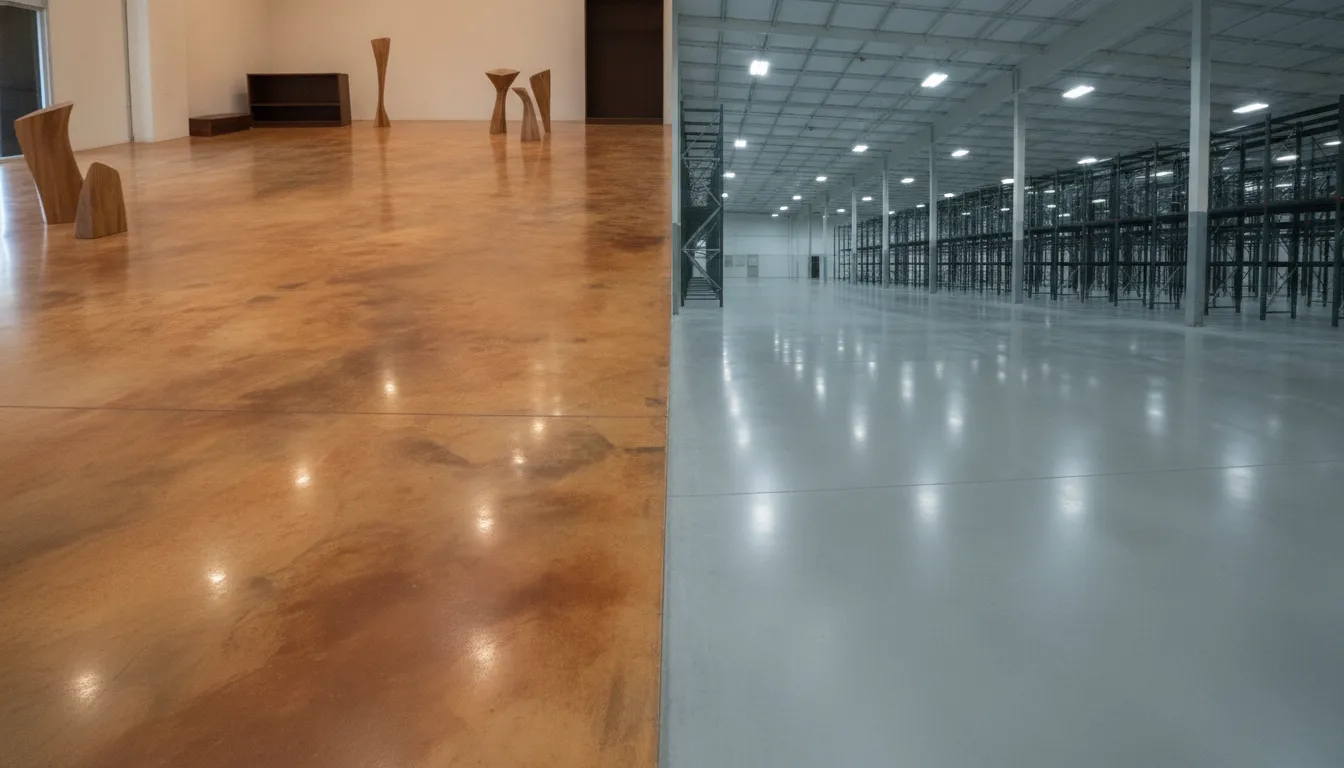
Choosing a concrete finish for a warehouse, showroom, restaurant, or office is not just a color decision. The existing slab, daily traffic, spill exposure, moisture, and the level of maintenance your team can support all help decide which finish fits. This stained concrete vs polished concrete comparison lays out the practical tradeoffs before you request an estimate.
Call (800) 518-9080 to request a free estimate
Stained concrete vs polished concrete comes down to the result you need. Staining adds color that soaks into the slab and is sealed. Polishing grinds and densifies the concrete for a refined, low-maintenance surface. Staining can create marbled or more uniform decorative color; polishing can deliver a selected sheen without a resin coating on top.
For buyers in New York, New Jersey, and Pennsylvania, the right choice also depends on the slab. It depends on how the floor is used when wet or under heavy traffic. Understanding how each system is installed makes the tradeoffs clearer, starting with the preparation and finishing steps that shape the final floor.
How stained concrete and polished concrete are made
The preparation starts with the existing slab in both cases. The concrete is cleaned, and cracks, surface damage, or other problems are evaluated and repaired where feasible. That step matters because neither finish can hide every defect in the slab beneath it.
How stained concrete is made
Staining changes the color of the concrete that is already there rather than covering it with a new floor layer. An acid-reactive stain can react with the slab to create varied, marbled earth tones. A water-based stain offers a broader palette and can produce a more uniform color. The selected stain soaks into the prepared concrete, and the floor is then sealed to protect the finished appearance.
The result depends on the slab's age, composition, previous repairs, and other conditions, so color variation is part of the character of many stained floors. Before applying stain, the surface still needs thorough cleaning and any practical repairs. Learn more about concrete staining options.
How polished concrete is made
Polishing does not add color by soaking a stain into the slab. Instead, contractors mechanically grind the existing concrete with progressively finer tooling. The surface is densified during the process and refined until it reaches the selected sheen and design level. Older or damaged concrete is assessed first, with repairs made where feasible before grinding begins.
Because polishing works the concrete itself, there is no resin coating sitting on top of the floor. The primary finish is not a conventional resin film, although a project may specify a guard or other treatment. Confirm the full system in the written scope. The final appearance comes from the prepared slab, the degree of refinement, and the chosen sheen. See how concrete polishing is performed on existing floors.
Look, light, and where each finish fits
Stained concrete is the more expressive option when the floor should contribute color and visual variation. An acid-reactive stain can create one-of-a-kind marbled movement in earth tones because it reacts with the existing slab. A water-based stain generally offers a more even, predictable color range. Either approach is followed by a protective sealer, so the final appearance also depends on the slab, sealer, and application. This makes stain a natural fit for retail showrooms, restaurants, offices, lobbies, residential interiors, patios, and basements where a decorative floor is part of the design.
For an area exposed to sunlight, UV-stable stain and sealer options are available. Confirm that the specific products are appropriate for the exposure rather than assuming every stain system will perform the same way outdoors or near strong windows. The existing concrete still matters: variation, repairs, and other slab conditions can show through the finished color.
Polished concrete keeps more of the slab's natural, industrial character. Mechanical grinding and densifying reveal and refine the existing surface, with optional color or design elements if a project needs more than the concrete's natural tone. The sheen can range from relatively low to high gloss. A reflective polish may bounce light through a room, which can be useful in warehouses, retail spaces, showrooms, restaurants, offices, and other high-traffic settings. Its appearance is less about adding a fully separate color layer and more about developing the character already present in the slab.
Neither finish is right for every room. Traffic, spills, moisture, slab condition, available light, and the desired visual effect all help decide which finish fits. A dark, wet area may need a different approach from a bright lobby, and a decorative residential floor may have different priorities from a working warehouse. A site assessment can help connect the finish to the room's actual conditions.
There are other paths when the project calls for a coated floor or a lighter-build treatment. Review epoxy flooring versus polished concrete for that separate decision, or consider concrete grind and seal as another finish option. Those systems should be evaluated on their own requirements rather than treated as interchangeable with stain or polish.
Stained concrete vs polished concrete, side by side
Stained concrete adds color that penetrates the slab, while polished concrete changes the slab's surface through grinding and densifying. The better fit depends on the appearance, traffic, and conditions the space must handle.
Both systems require preparation, but they create different finished floors:
Stained concrete compared with polished concrete
| Factor | Stained concrete | Polished concrete |
|---|---|---|
| How it is made | Stain penetrates the slab, then the floor is sealed. | The slab is ground and densified; confirm whether any guard or other treatment is included. |
| Look | Decorative color, from marbled earth tones to more uniform color. | A chosen sheen, color, or design with a polished surface. |
| Best-fit spaces | Decorative retail, restaurants, offices, and patios. | Warehouses, retail, and other high-traffic commercial spaces. |
| Upfront work | Needs preparation; no published installation duration. | Needs preparation; timing depends on area, slab, access, repairs, and selected sheen. |
| Day-to-day care | Refresh the sealer in high-traffic areas as needed. | Dust mop and damp mop; no waxing or stripping. |
| Sun and outdoor use | UV-stable stain options are available for sun-exposed areas. | Used here as an indoor commercial finish. |
| What can go wrong | Cracks, coatings, moisture, and deep stains can change the result. | Cracks, coatings, moisture, and deep stains can change the result. |
The right choice depends on the slab and the work the room does. A decorative patio or restaurant may call for a different system than a warehouse or heavily trafficked retail floor.
Traffic, spills, and traction
Daily use can expose an important difference between stained and polished concrete. A polished floor is mechanically refined and densified, which helps harden the surface against dusting and supports a low-maintenance finish in busy spaces. Stained concrete can also perform well when it is properly sealed. The stain supplies color within the slab, while the sealer provides the protective layer that helps the floor handle ordinary dirt and spills better than bare concrete.
Neither finish is stain-proof. Oils, abrasion, and repeated foot or equipment traffic gradually wear the sealer, especially along entrances, service counters, aisles, and other concentrated-use areas. A high-traffic stained floor may need occasional resealing to keep its protection in place. That maintenance decision depends on the sealer, traffic pattern, cleaning routine, and condition of the slab, not on the stain color alone.
For harsh chemical exposure or frequent aggressive spills, a coated floor may be a better fit than either decorative staining or polished concrete. Neither system should be described as chemical-proof or automatically food-safe. The right recommendation depends on what is spilled, how quickly it is cleaned, and whether the floor must tolerate repeated abrasion from carts, forklifts, or production activity. A site assessment can identify those conditions before the finish is selected.
Traction also depends on more than the label "stained" or "polished." Sealer type, sheen, surface texture, and whether the floor stays wet all affect how it feels underfoot. Glossy polished concrete and smooth sealed stain can be slippery when wet, so wet zones deserve particular attention during a site visit. In commercial settings, 29 CFR 1910.22 says employers must keep walking-working surfaces clean and, to the extent feasible, dry. Where wet processes are used, employers must address drainage and provide dry standing places where feasible.
That does not mean one finish is automatically safer. It means the floor system and the surrounding operation should be considered together. Look at entrances, wash-down areas, drains, spill response, and traffic routes. That review shows whether a smoother sheen needs a traction treatment, or whether another finish is more practical. When the goal is a refined, durable surface with predictable upkeep, polished concrete is one option to evaluate alongside stained concrete.
What changes the cost and the upkeep
There is no single price for either finish because the concrete underneath matters as much as the finish selected. Slab repairs, site access, the sheen you want, and the layout can all change labor, materials, and preparation. Polishing may also require more equipment and process steps than staining. A Sherwin-Williams concrete specialist has observed that polished work often costs about $5 to $8 more per square foot than a stained project. That is an industry comparison, not an Alliance quote. See the Sherwin-Williams comparison of stained and polished concrete for the source.
Alliance does not publish a per-square-foot price for staining. Its cost guide gives polished concrete a typical industry budgeting range of $4 to $9 per square foot, not a promised project rate. You can review the assumptions behind that range in the epoxy and polished concrete cost guide. The only accurate figure for a specific floor is a written on-site quote after the slab and site conditions have been assessed.
What upkeep looks like
Indoor stained concrete can last for decades when it is protected with a sealer, although that is not a guaranteed service life. Busy areas may need resealing from time to time as the protective layer wears. The timing depends on traffic and use, so it should be treated as maintenance planning rather than a warranty.
Polished concrete has a simpler routine: dust mop regularly and damp mop when needed. It does not require waxing or stripping. The schedule depends on the area, the slab's condition, access, repairs, and the selected sheen. Staining has no published installation duration, so the schedule should be confirmed in the project scope rather than assumed. A site review can account for the existing slab, access, repairs, and the appearance you want before work begins.
How to choose stained concrete vs polished concrete for your space
Use this sequence before comparing proposals:
- Start with the job the floor has to do. List traffic, equipment, spills, moisture, cleaning methods, and any unusual exposure.
- Define the appearance. Decide how much color variation, aggregate exposure, sheen, and visible repair work the team can accept.
- Match the system to the slab and schedule. Ask how preparation, repairs, access, work zones, and care requirements affect the recommendation.
Start with the job the floor has to do, not with a catalog photo. Stain is the stronger lean when the goal is custom color or marbled variation. That fits a customer-facing room, a lobby, a restaurant, or a sun-exposed patio, after the stain and sealer are confirmed for that light and traffic. Polish is the stronger lean when you want a hard, reflective surface that stays simple to clean. That fits a warehouse, a retail floor, or another high-traffic interior, if the slab is sound enough to grind.
Both can miss the brief. A failing coating, active moisture, or damage that ordinary prep cannot fix will show up in the finished floor, whether the plan is color or sheen. Deep oil staining can remain visible. Wet production areas and harsh chemical spills may need a coated system instead of either of these two. That is a different decision from the one this comparison is built to answer.
Alliance Epoxy Flooring installs both stained concrete and polished concrete in its advertised territory. That includes the New York City area, northern and central New Jersey, Philadelphia, and Pennsylvania near the New Jersey border. Confirm the site is in the service area before scheduling a visit. A crew looks at the slab, the use, and the access before recommending one. You can request a free estimate and send a few photos so the first conversation starts from the floor you actually have.
Frequently asked questions
What is the downside of stained concrete?
The color is only as even as the slab, and protection sits in the sealer rather than in a thick coating. Busy aisles wear that sealer, so high-traffic floors need resealing from time to time. Oils and abrasion can mark the surface, and sun-exposed areas need a UV-stable system confirmed for that exposure. It is a decorative finish, not a chemical-proof one.
What is the downside of polished concrete?
Polishing takes more equipment and more steps than staining, so the upfront cost is often higher. The look stays closer to the natural slab, with less room for a custom color story. A glossy surface can be slippery when wet, and harsh chemical spills are a weaker fit than a coated floor. It is also not stain-proof.
Is staining concrete a good idea?
It is a good idea when you want lasting color on concrete you already have, especially in showrooms, restaurants, offices, lobbies, and patios. Acid stain gives marbled earth tones. Water-based stain gives a wider, more even palette. It is a weaker idea when the slab is badly damaged, stays wet, or takes harsh chemicals every day.
Are stained or polished concrete floors slippery?
They can be, when the surface is smooth or glossy and the floor is wet. Traction depends on the sealer, the sheen, any texture, and whether water sits on the floor. A site visit should flag wash-down areas, entries, and other wet zones before a sheen is chosen. No finish here comes with a measured slip rating.
Which costs more, stained or polished concrete?
Polishing usually costs more up front because of the equipment and the grinding steps. Alliance does not publish a staining price. Its cost guide lists polished concrete at a typical industry range of $4 to $9 per square foot, which is budgeting guidance, not a quote. Slab repairs, access, and sheen change the number. A written on-site estimate is the only accurate figure.
Get a floor recommendation based on your slab
Stained concrete and polished concrete start from the same slab and end in different floors. Color and a sealed decorative surface suit one set of rooms. A ground, densified, low-care surface suits another. The slab condition, the traffic, and the spills decide which one is worth installing.
Request a free estimate or call (800) 518-9080. Alliance Epoxy Flooring will look at the concrete and the way the space is used. They will recommend stained concrete, polished concrete, or a different system if the slab calls for it.